
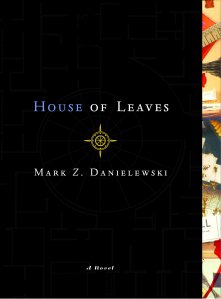
When one were to be questioned what exactly the novel ‘House of Leaves’ is about, Mark Z. Danielewski observed that most would answer along the lines of “about a house that is bigger on the inside than it is outside” (“Conversation”). It is not wrong, nor is it entirely true, but ‘House of Leaves’ does indeed leave you thinking more about the shape-shifting house, and more about the depths of the human mind.
House of Leaves (2000) is Danielewski’s debut novel that became a sensational bestseller in the contemporary literature section, a modern day psychological thriller and horror. The novel sits on the narratives of three different people, with layers of unconventional footnotes and appendices. Alternating between the narrative of Johnny Truant’s journey on a recently deceased named Zampano and his manuscript, to the narrative of Zampano’s manuscript of a possibly fictional documentary film of the Navidson Record, to Will Navidson’s record of his findings about his shape-shifting house in which he named it as ‘The Navidson Record’.
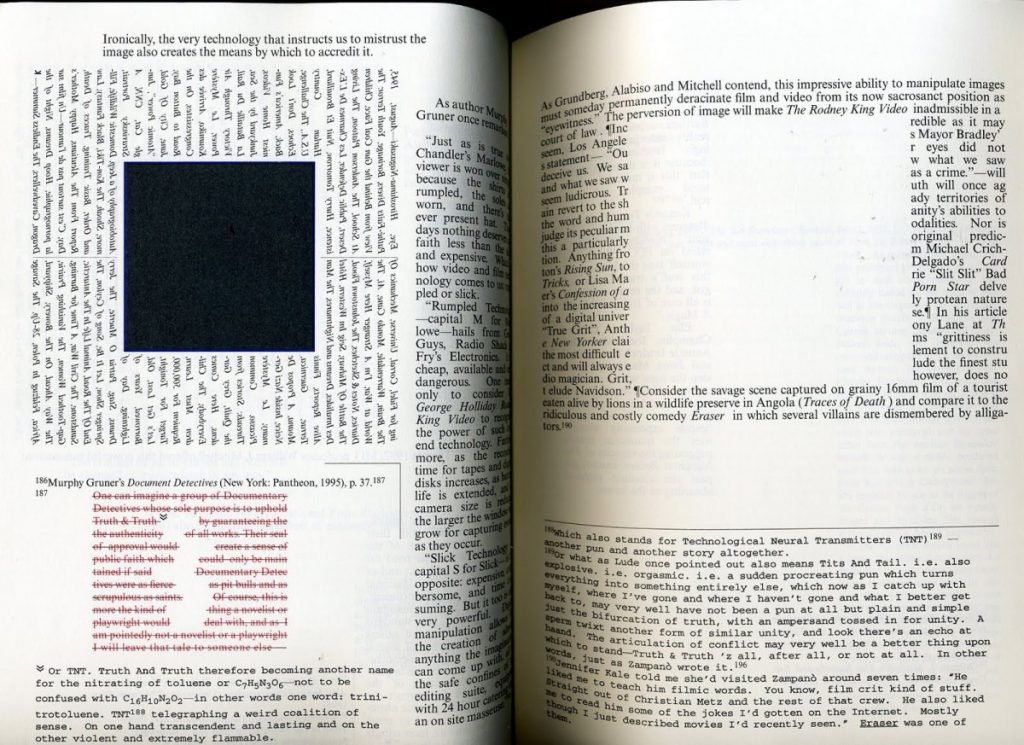
It is a prime example of ergodic literature, creating a scenic visual similar to a black-and-white film with its strange and claustrophobic layouts in each page. The text functions in a way where it leaves readers feeling the exact emotion as intended in the words; of the deafening silence, of the crippling fear of being watched, of the sinking sensation of being left alone in a dark hallway. It is worthy to note that the author himself personally did the typesetting himself to guarantee the best portrayal of the book’s vision (Kirschenbaum, 203).
Works Cited:
Danielewski, Mark Z. “A Conversation with Mark Danielewski.” Conducted by Sophie Cottrell. 2002. http://www.randomhouse.com/boldtype/0400/danielewski/interview.html
“House of Leaves.” Penguin Random House, 2019. https://www.penguinrandomhouse.com/books/36526/house-of-leaves-by-mark-z-danielewski/
Kirschenbaum, Matthew G. “Track Changes: A Literary History of Word Processing”, page 203.

 Amienah Simangoon